
Recently BBC Journalist and Documentary Maker Catherine Carr visited Carmarthen Youth Project DrMz to spend some time with their Girls group, what follows is an extract from an article written about that visit and the wider series About the Girls:
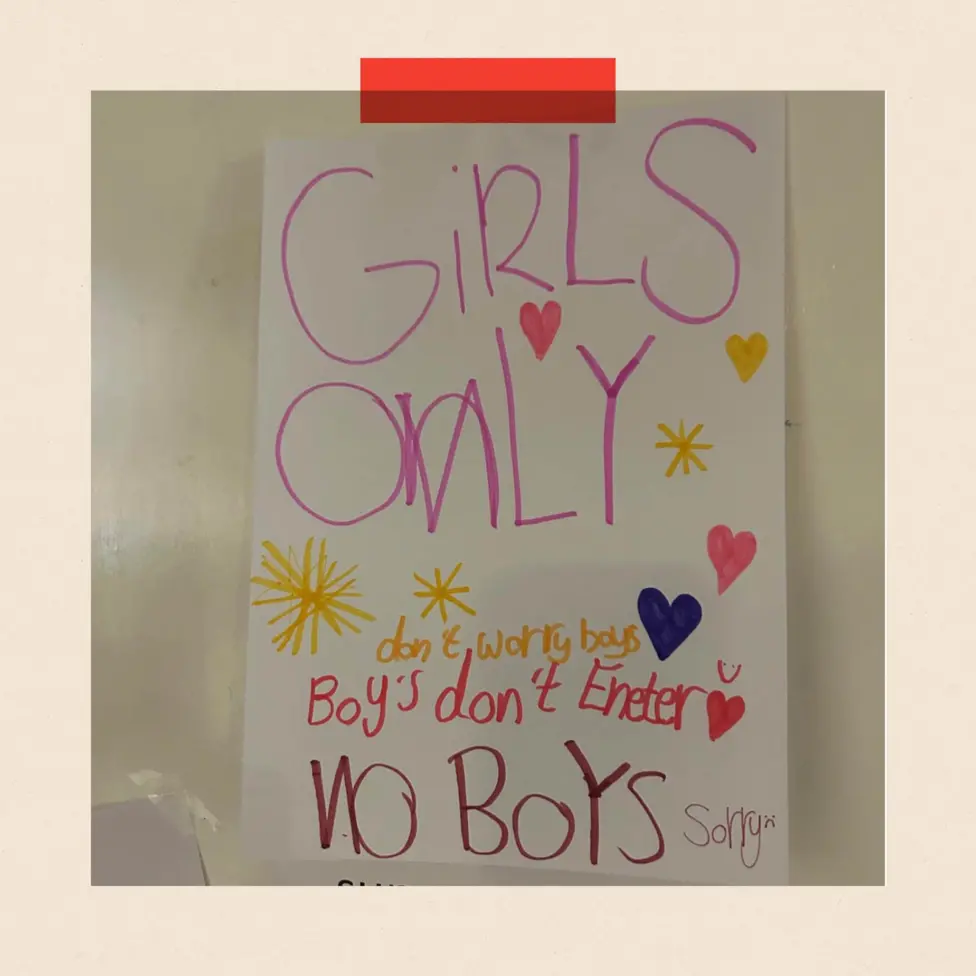
A felt‑tip sign taped to the door of a private room announces “GIRLS ONLY”, “Boy’s don’t Eneter!” [sic], and, by way of a cheeky flourish, “don’t worry boys!”. The sign is covered in colourful hearts and stars. A group of around a dozen girls at DRMZ youth club in Carmarthen, Wales, are already deep into a competitive card game when I join them at a large round table. Conversation flows easily as we chat and pizza is duly ordered.
This visit is part of my Radio 4 series About The Girls, for which I spoke to roughly 150 girls, the vast majority aged between 13 and 17. What we discussed at that table echoed so many of those conversations.
Savvy, chatty, funny and bright, the girls were uplifting and brilliant company. Full of ambition and plans for their futures (“I would like to have a fridge that you can have a vase in… And be a doctor!”), love for their friends (“I can tell her anything”) and a great awareness of the value of caring for family members (“I go to town to top up my Nan’s electric. I love looking after her.”)
The conversation hopscotched between the card game at hand, school dramas, teachers they like (and those they don’t), stuff they’d seen on social media and debate about whether there were enough slices of Cheese Feast to go round. There were.
This project follows my series About The Boys, for which I also spoke to teenage boys from all over the UK. In the wake of Covid-19, #MeToo and all the noise about Andrew Tate, I was curious to know what they were thinking. I also found them excellent company: thoughtful and articulate and brave. Repeating the experiment with girls next seemed logical and fair. It happened that the Epstein files were released just as I set off for Carmarthen, and the work suddenly felt even more urgent.
What I was not expecting was that across all the conversations I had, one theme kept resurfacing: teenage girls still tend to see themselves through the lens of boys. And, importantly, there seems to be an acute understanding of this.
When I asked my opening question “What is it really like to be a girl in 2025/26? Tell me the truth, don’t be polite!” The answer almost invariably began with the words: “Well boys think/say/want/ feel…”. These conversations felt like some odd real-life version of the Bechdel Test. Which, in case you are not familiar, provides a metric for evaluating female representation in films. To pass the test, a film (1) has to have at least two named women in it, who (2) talk to each other, about (3) something besides a man. None of my interviews would pass.
“Growing up as a girl,” said one “so much of that is about how boys are behaving around you and what they’re doing to you. So there isn’t really a way to talk about that without mentioning boys… and it is frustrating.”
So why does this dynamic persist? The girls I met talked fluently about the weight of gendered social expectations, the influence of boys in school environments, versions of feminine “perfection” seen endlessly on social media, and described something deeper about how girls learn to behave while trying to safely navigate the world.
‘Not making a fuss’
After the girls in Carmarthen had all gone home, I spoke to Alison Harbor, manager at the youth centre. She was delighted that they had all talked so freely.
“The boys at the club are quite vocal” she told me, “and pretty confident in telling you all their opinions and thoughts. Well today, the girls have been the same! My worry is that they usually internalise a lot of their troubles…”.
Though the girls did not hold back, the irony was that almost all of them said their behaviour was different than when boys are around.
Girls told me about not wanting to be seen by boys as “too much”, “too loud”, “weird”, “annoying”, a “pick me”, or “a beg” (someone looking for attention). They told me how boys can be loud and funny, but that girls had better not. They described not wanting to “take up space” and trying to be “smaller and quieter” in mixed company.
You can read the rest of the article and find out more about the series here; The surprising reality of how teenage girls still define themselves – BBC News